
Hudson County Community College Students Contribute to One of the Largest Soil Microbiome Mappings in the United States
February 20, 2026
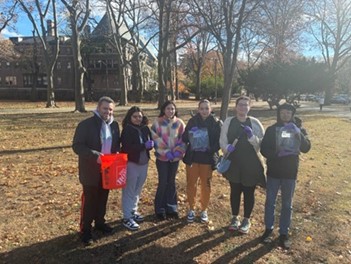
Hudson County Community College students and alumni contributed to one of the largest soil microbiome mappings in the United States. Pictured here, from left: HCCC Instructor of Chemistry Raffi Manjikian, and students Katerin Marquez, Ashley Medrano, Alketa Muja, Zoe Canizares, and Aadil Ishtiaq.
February 20, 2026, Jersey City, NJ – Lincoln Park is one of the jewels of Hudson County, with 150 acres of athletic facilities, playgrounds, track, golf courses, and kayak rentals on the scenic Hackensack River. Statues commemorate Abraham Lincoln and other historic figures and times. The park’s foundation – its soil – is part of the planet’s most biodiverse habitat, the source of more than half of all existing species. Its microorganisms largely remained unstudied – until now.
Hudson County Community College (HCCC) students, guided by Instructor of Chemistry Raffi Manjikian, spent a week collecting soil samples in Lincoln Park for one of the largest soil microbiome mapping projects ever attempted. Students and alumni who participated in Biodiversity and Informatics for Genomics Scholars (BioDIGS) were members of the local American Chemical Society chapter. Students and alumni Ashley Meddano, Alketa Muja, Zoe Canizares, Katerin Marquez, and Aadil Ishtiaq are majoring in Biology, Nursing, Chemistry, Education, and Business, respectively. Professor Manjikian and the students were part of the BioDIGS consortium, which involved about 150 researchers across many institutions, who collected samples and catalogued the findings.
The BioDIGS consortium combed through more than 40 locations throughout the United States, including farmlands, hiking trails, forests, parks, and Superfund sites. Students received pre-assembled soil collection kits and sent their samples to Johns Hopkins University where analysis and DNA-sequencing was leveraged to unlock microbial genomes. Scientists and students looked for genetic relationships and patterns between the soil, the environment, and human health. Their work was published in the prestigious journal Nature Genetics.
The consortium logged more than 1,000 newly discovered bacteria strains, a fraction of the planet’s microbial “dark matter.” Research revealed information about arthropods, annelids, nematodes, plants, fungi, bacteria, archaea, bacteriophages, and other microbial species.
As a faculty fellow of the Genomic Data Science Community Network (GDSCN), Professor Manjikian provided students with the rare opportunity to engage in real-world scientific inquiry supported by the National Human Genome Research Institute and the National Science Foundation. “GDSCN works towards a vision where researchers, educators, and students from all backgrounds can fully participate in genomic data science research,” he said.
“My participation in the BioDIGS project began with a simple curiosity about the soil in Lincoln Park, a heavily frequented public space in Jersey City,” said HCCC alumnus Aadil Ishtiaq. “By contributing to this broader comparative study, I hope to gain insights into the potential variations and similarities in soil microbiomes, revealing how human activity and environmental factors shape these essential ecosystems.”
“We are very proud of our students and Professor Manjikian for their contributions in this important work that involved more than 40 research and teaching institutions,” said HCCC President Dr. Christopher Reber. “The BioDIGS project is vital to understanding the soil microbiome and its impact on animals, plants, and humans, its relevance to STEM (Science, Technology, Engineering and Mathematics) education, and the advancement of data science.”