
Hudson County Community College Apprenticeship Program Featured in The Chronicle of Higher Education Case
March 24, 2026
March 24, 2026, Jersey City, NJ – Recently, Hudson County Community College’s (HCCC) innovative Holz Technik dual-education program was spotlighted as a case study in the esteemed educational publication, The Chronicle of Higher Education.
The case study, “An Earn-and-Learn Model Closes Skills Gap,” details how the College partnered with Eastern Millwork, Inc. (EMI) and created an apprenticeship program to address workforce shortages in automated custom architectural woodworking design and production.
Eight years ago, EMI Founder and Chief Executive Officer Andrew Campbell needed a pipeline of talented employees who understand the art and science of the design and manufacturing process. Several colleges and universities were unable to provide the programs leading to the expertise he required. “They (engineering college graduates) were not really ready for us,” Campbell said. New hires required significant training, “but they had now spent hundreds of thousands of dollars on an education that, honestly – to me – brought no value.”
The HCCC-EMI collaboration and resulting Holz Technik earn-while-you-learn program
forged with HCCC is now a national model, earning awards and praise from business,
industry, academic and government leaders.
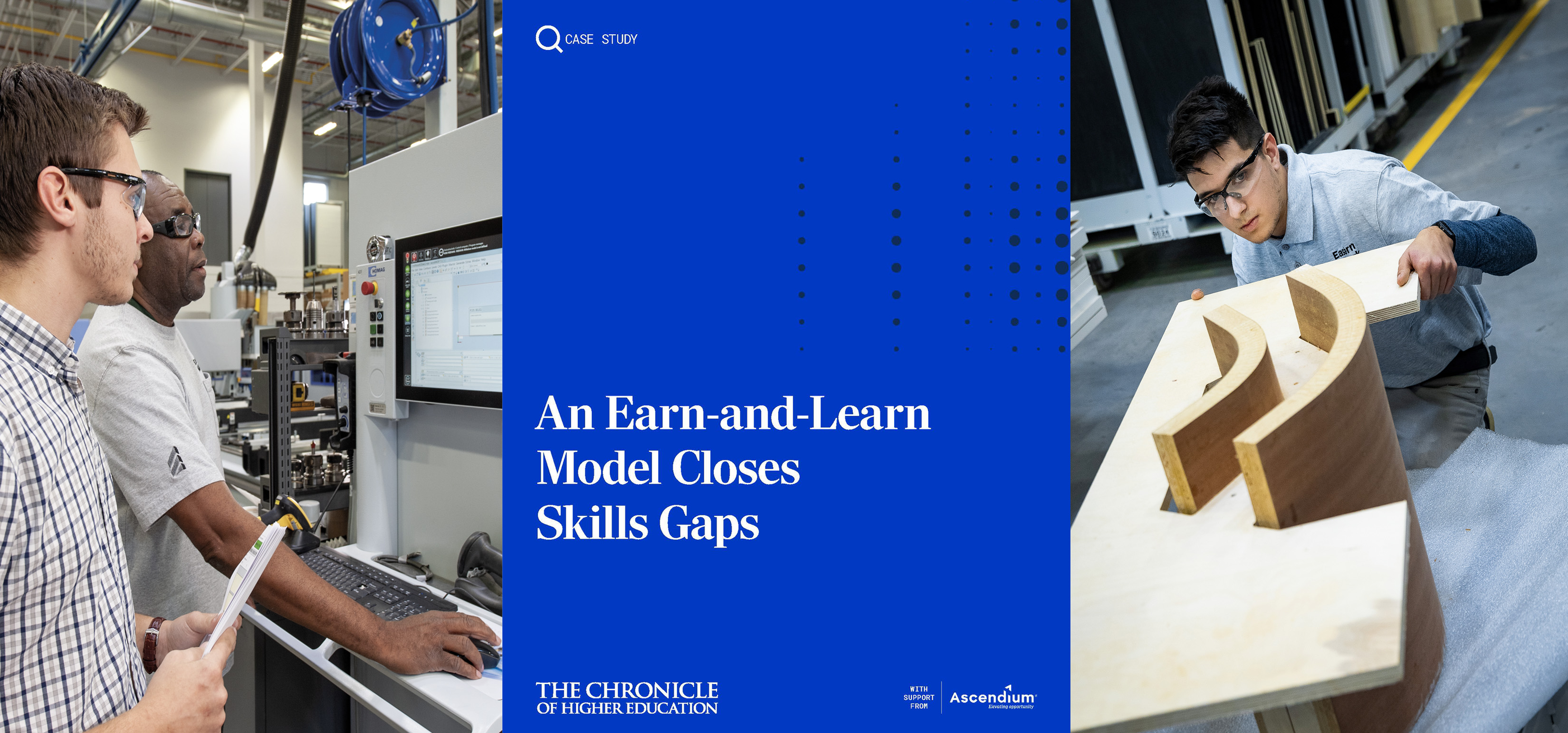
The Chronicle of Higher Education recently published a case study, “An Earn-and-Learn Model Closes Skill Gaps,” on
the nationally acclaimed Hudson County Community College-Eastern Millwork, Inc. Holz
Technik apprenticeship program.
View Case Study
In 2018, HCCC and EMI developed Holz Technik Academy to address strategic workforce development needs. They selected apprentices from gifted high school STEM students who would split their time between HCCC and EMI. Apprentices earn a $31,500 starting salary with full benefits, vacation, and incremental annual raises. At the end of the five-year program, apprentices have received their Associate of Applied Science (A.A.S) degree in Advanced Manufacturing from HCCC, and Bachelor of Science (B.S.) degree in Technical Studies from HCCC partner Thomas Edison State University – both debt-free. They earn up to $70,000 and generous benefits at EMI and continue there with long-lasting careers and family-sustaining wages. Former Governor Phil Murphy called the program “a blueprint for New Jersey’s economic future.”
Driven by the financial incentives and support system, Nico Monzon scrapped plans to study architecture in favor of attending the Holz Technik Academy. He tried various roles in the apprenticeship, starting with organizational tasks, then developed his skills, earned supervisors’ trust, and contributed to real-life projects like designing and using AutoCAD software. “They invest in us, they make us feel comfortable in the environment, and then we produce for them,” Monzon said of EMI management. Andrew Campbell emphasizes that he would have seen some apprentices “go south” if not for the College’s support network.
The inaugural Holz Technik Academy cohort of five high school graduates was selected in 2019. New apprentices join the highly competitive program each year. “As on-the-job training intertwines with the more traditional college degree, many students select it as an accelerated, lower-cost education that’s tailored to their chosen occupation,” the report reads, noting the growth of apprenticeships is up to 27,000 registered programs according to the U.S. Department of Labor. Apprenticeships are valued and vetted by the labor market, providing a reliable workforce that businesses depend on, noted Taylor White, Director of New America’s Postsecondary Pathways for Youth.
Since 2018, HCCC grew its workforce development programs from four to eighteen. “We’ve seen a steady increase in the number of credentials offered, the number of partners we’re working with, and, with that, revenue through grants and other forms of support that continues sort of a snowball effect,” said HCCC President Dr. Christopher Reber. HCCC’s School of Continuing Education and Workforce Development now serves more than 12,000 students annually and generates more than $1 million in revenue that supports continuing entrepreneurial program development.
Lori Margolin, HCCC Vice President for Strategic Initiatives called the EMI partnership “a trifecta for students, the College, and EMI.” Holz Technik Academy is just one partnership in the HCCC School of Continuing Education and Workforce Development she leads.
Dr. Reber noted that colleges should focus on meeting students where they are and helping them get to where they want to be. This involves cultivating a culture of care by expanding and scaling workforce development programs while eliminating barriers and providing support.