
Celebrating and Remembering the Life and Legacy of Artist David Acker
May 21, 2026
May 21, 2026, Jersey City, NJ – The Hudson County Community College Foundation Art Collection has long celebrated and showcased the work of artists from traditionally underrepresented communities, including the LGBTQ community. Today, it also plays a pivotal role in bringing renewed visibility to the memory of talented artists whose work and stories might have otherwise faded from view over the decades. In doing so, the Collection becomes more than a repository of artwork; it serves as a living archive of memory, resilience, and rediscovery.
One such story that deserves to be remembered and reexamined is that of David Acker.
Born in Lima, Peru in 1954 to American parents, Acker came to the United States with
his family in 1957. His early life was marked by personal hardship, including the
loss of his mother at a young age. He was shy and struggled while growing up and going
to school in New Canaan, Connecticut, but he was driven by his creative spirit and
carved out his own path. At Earlham College in Indiana, he pursued a double major
in Biology and Art. He worked as an intern and apprentice to the artist Nell Blaine,
assisting her on several trips to Europe.
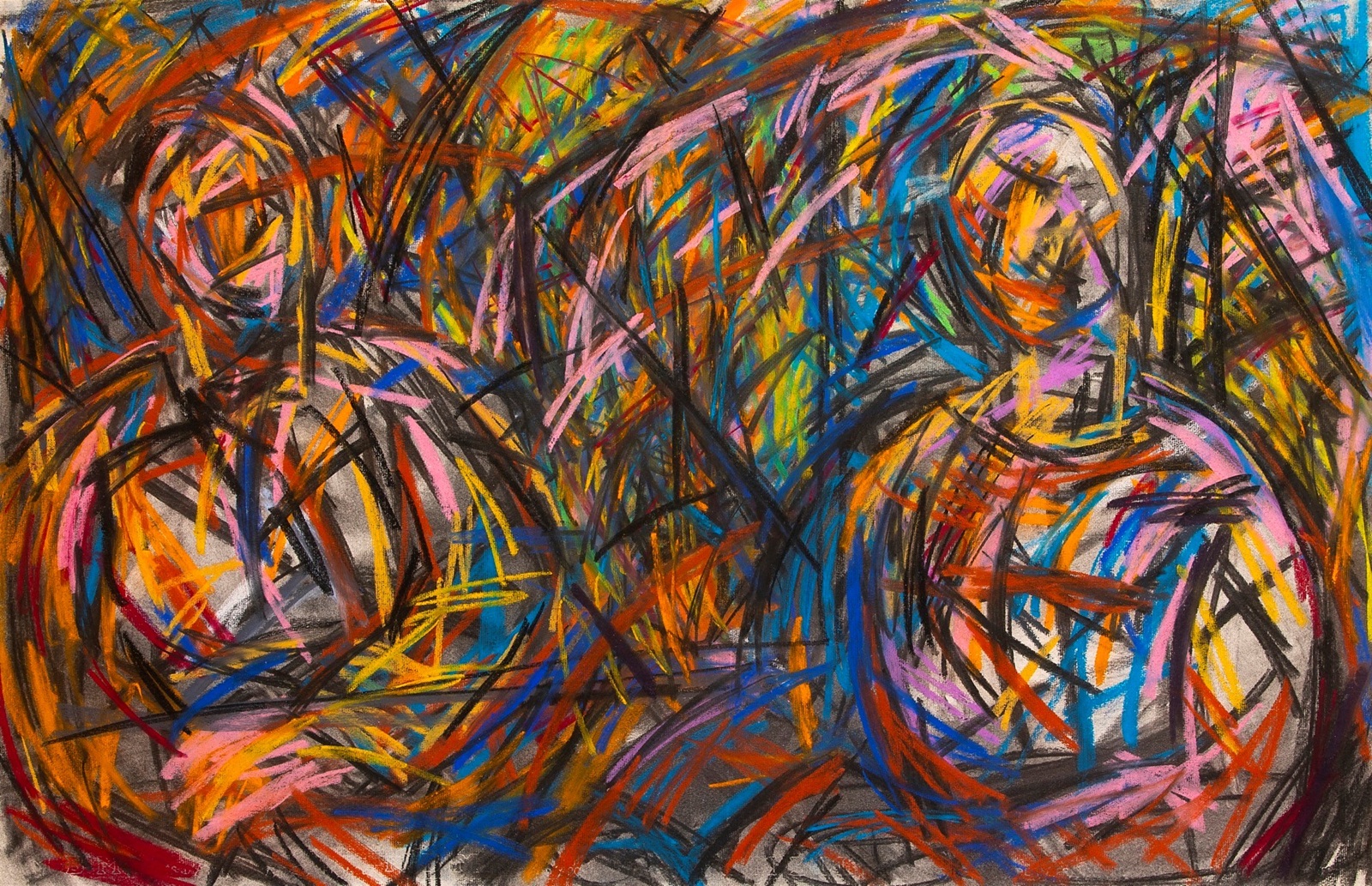
“Two Figures” by David Acker, 1980, Oil pastel, 25.75” x 39.5”.
After graduating in 1975, Acker moved to New York City, where he attended the New York Studio School and immersed himself in the vibrant and demanding downtown art scene of the day. He worked as a typesetter for The Nation magazine, while throwing himself fully into his artistic practice.
Those who knew Acker describe a transformation from a shy, sensitive child into a dynamic and socially engaged artist. He was deeply committed to his work; his friend, the artist Judy Hoffman, recalls an “intense, dedicated artist.” Yet he was also generous, thoughtful, and kind. Friends fondly remember him as a superb cook who threw wonderful parties. He formed close friendships within the artistic community, including fellow artists such as Hoffman and Flavia Bacarella, both of whom remembered his encouragement and generosity. He shared studio space, celebrated their successes, and pushed those around him to pursue their own creative paths. Acker encouraged Hoffman to attend the Studio School. Bacarella recalls how “David shared with me all he knew. . . endless phone calls over little details about how to put a show together, how to present your work and yourself to the public. But most of all, he offered himself and his absolute standards of perfection, and I accepted these as his gift of friendship to me.”
Acker also came into his own identity as a gay man despite it being a time of significant social stigma for the LGBT community. While he first came out as gay to his brother, Peter, with whom he was very close, he later shared this part of himself with his more conservative father, who responded with an unexpected openness, acceptance, and a genuine desire to understand his son better.
In New York City, Acker lived more freely and became part of a community of artists who were both creatively ambitious and socially connected. In the early 1980s, he joined the Prince Street Gallery, an artist-run cooperative, where he held his first solo exhibition. His work, bold in color, expressive in form, and often infused with a sense of vitality and play, began to gain wider recognition. He conducted two residencies at the Djerassi Foundation in California, exhibited in group shows, and put on a solo show.
David’s promising career trajectory also unfolded alongside a growing and poorly understood crisis. In the early 1980s, AIDS – then often referred to as GRID (Gay-Related Immune Deficiency) – was devastating the gay community, and patients were burdened by a climate of intense fear and social stigma.
David began to worry about his health, and in 1986, he was admitted to Columbia Presbyterian Hospital with complications that quickly escalated. Within weeks, he was gone, shocking and devastating his friends and loved ones. He died on May 1, 1986, at just 31 years old.
In his final days, unable to speak, David communicated by writing in his notepad – reassuring friends with messages like “I’m optimistic,” and telling his loving father “I love you so much dad.” His sudden decline and death were deeply traumatic for those closest to him, including his longtime partner Randall Cherry, who had expected his recovery.
Acker’s passing marked not only a personal loss for his friends, family, and the artistic community, but also a broader cultural tragedy. The AIDS epidemic wreaked havoc on a generation of artists, thinkers, and creators, leaving behind unfinished work, unrealized ambitions, and unfulfilled potential. Friends and colleagues honored Acker through memorial exhibitions and tributes, recognizing both the significance of his artwork and the warmth of his spirit. His name was included in the AIDS Quilt, the world’s largest community art project, featuring over 50,000 handmade panels honoring the lives of the over 110,000 individuals who died as a result of the AIDS epidemic.
Critics and fellow artists saw in David’s work a remarkable vitality. The artist Joyce Pesanto described it as filled with “a spirit of life. . . whether it was tropical trees from Prospect Park or isolated men sitting on a New Jersey pier overlooking the Manhattan skyline,” while Nell Blaine remarked on the “comet-like” rise of his ascendance in the art world – sudden, brilliant, and sadly brief. His paintings and drawings, whether landscapes or portraits, carried an energy that continues to resonate. Blaine reflected that, “The work left behind is a precious body of drawings and paintings: vibrantly alive and enduring. The warmth so characteristic of David as a person now emanates from those remarkable paintings.” Later on, one of his works, an etching called Waterfront People, entered collection of the Smithsonian American Art Museum, serving as a testament to David’s talent and impact.
Forty years later, the Hudson County Community College Foundation Art Collection is helping ensure that David Acker’s story – and his art – are not forgotten. The Collection is the proud home to eleven of his works, including charcoal drawings, pastels, and watercolors, preserved in the Foundation Archive at the Gabert Library on 71 Sip Avenue in Jersey City. Through these works, Acker’s voice continues to resonate, and his memory lives on – vivid, expressive, and enduring.
This renewed spotlight on David Acker is the result of dedicated firsthand research and collaboration. Dr. Andrea Siegel, coordinator of the HCCC Foundation Art Collection, worked closely with Acker’s family, friends, and fellow artists to reconstruct his life story. Dr. Siegel explained her inspiration for learning more about David and his life: “When we won a Jersey City Arts + Culture Trust fund grant to teach students to write about art, many wanted to write about David Acker, but Google had nothing, and we felt David deserved more. So, we gathered stories thanks to his friends, partner, and family. We hope to share the longer biography later this year on our website.” These memories, generously shared, offer a portrait not only of a talented young artist, but of a profoundly human presence: intense, ambitious, and passionate, yet kind and full of life.
HCCC President Dr. Christopher Reber stated, “We are honored to preserve and celebrate the work of David Acker. By bringing renewed attention to artists like David, the Foundation Art Collection not only safeguards important works of art, but also reconnects us with stories that deserve to be remembered and shared.”
As we mark the 40th anniversary of Acker’s death this May, his story takes on renewed and profound significance. It is both a remembrance and a recognition – of a life interrupted, of a community impacted, and of a legacy that still matters today.
As we head into Pride Month, remembering David Acker also means honoring the countless individuals who left us too soon as a result of the AIDS epidemic. It is a moment to reflect on the resilience of the LGBT communities, the importance of bringing visibility to their stories, and the lasting power of art to carry legacies forward.
Through the HCCC Foundation Art Collection, David Acker’s work has found a permanent home –and in that home, his life and legacy continue to radiate, inviting new generations to see, feel, and remember.
HCCC’s Foundation Art Collection, which features more than 2,200 paintings and other works displayed throughout the College’s two campuses in Jersey City and Union City, remains one of the area’s most distinctive college art collections. The Foundation Art Collection continues to grow through relationships and word-of-mouth among artists, collectors, and donors who support the College’s mission.
The HCCC Foundation Art Collection invites community members, alumni, and supporters of the arts to help sustain its impact. Collections of this magnitude serve as teaching tools for HCCC students studying art, culture, and the humanities, while also providing a resource for K-12 students and the broader Hudson County community who engage with the College’s campuses and programs.
A collection of this scale requires ongoing conservation, framing, transportation, and professional stewardship to ensure the works remain accessible and preserved for future generations. To support this work, the HCCC Foundation is building an endowment for the Foundation Art Collection and seeking philanthropic support to help preserve, interpret, and share these works with students and the community for years to come.
Members of the public may support the Foundation Art Collection financially by making a gift at https://www.hccc.edu/community/foundation/index.html or emailing foundationFREEHUDSONCOUNTYCOMMUNITYCOLLEGE for more information on how you can help.
For more information about the HCCC Foundation Art Collection and to view it online, please visit: https://www.hccc.edu/community/arts/foundation-art-collection/index.html
You can view the works of David Acker and other artists in the Foundation Art Collection online at: https://www.artworkarchive.com/profile/hudson-county-community-college-foundation-art-collection/portfolio?public_piece_search=david+acker&general_filter=